View a video series on the History of the Murray=Darling Basin by the Inspector General of Water Compliance here.
How did the Basin Plan (MDBP) come about?
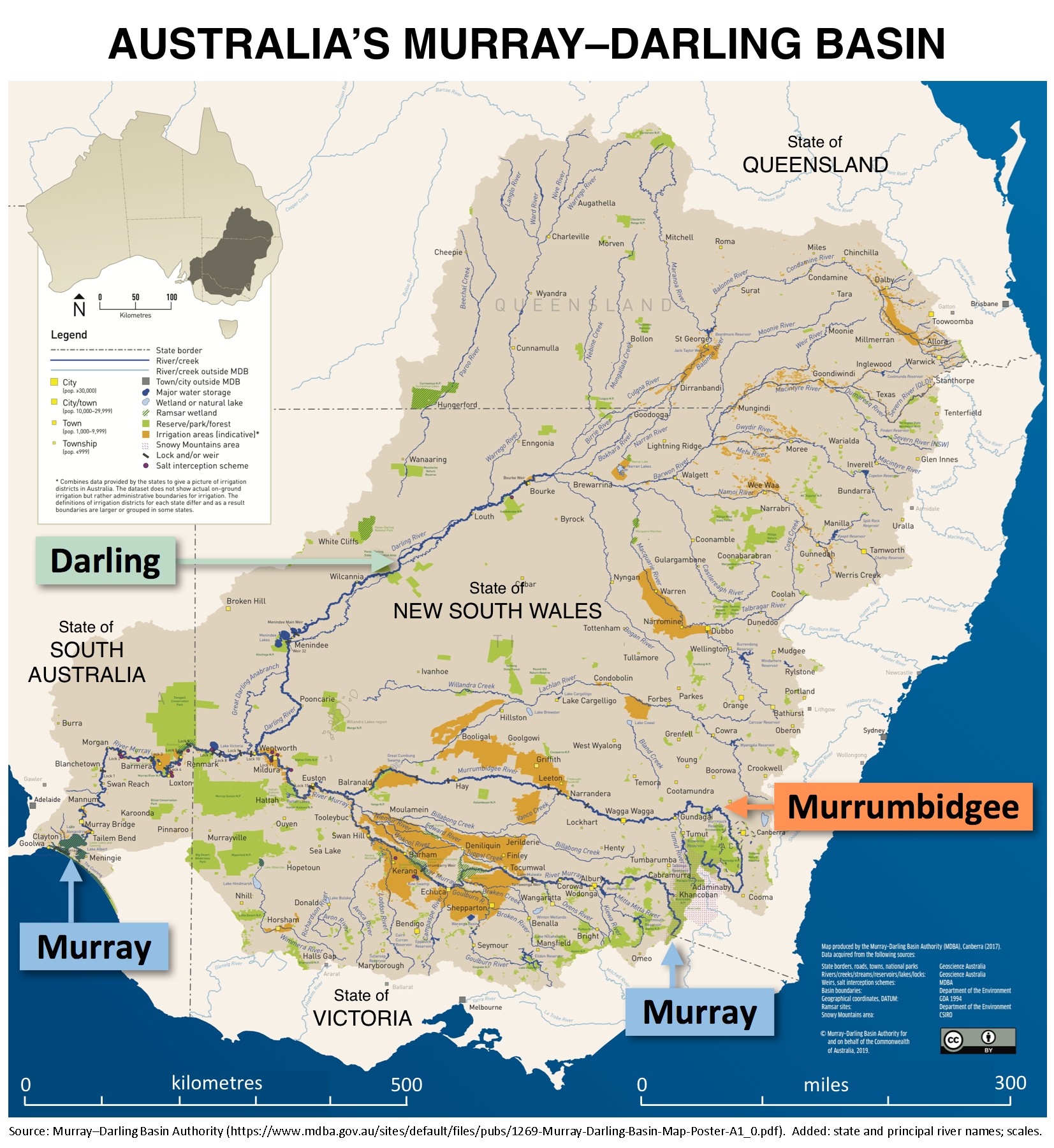
The waters of the Murray-Darling basin were one of the most bitterly contested issues during federation, with the states retaining the rights to management of all water issues via Section 100 of The Constitution with the Commonwealth having power only so far as the States agree. (http://www.austlii.edu.au/au/legis/cth/consol_act/wa200783/). However, it was agreed by the States in 1914 that South Australia, which has no major tributaries to the Murray will receive a guaranteed 1,850 GL/y to be provided equally by NSW and Victoria.
From this guaranteed flow, South Australia supplies water to irrigators, drinking water to Adelaide and many rural towns and running water to the sea to flush salt from the system.

(Click here for full size map of Australia’s Murray-Darling Basin)
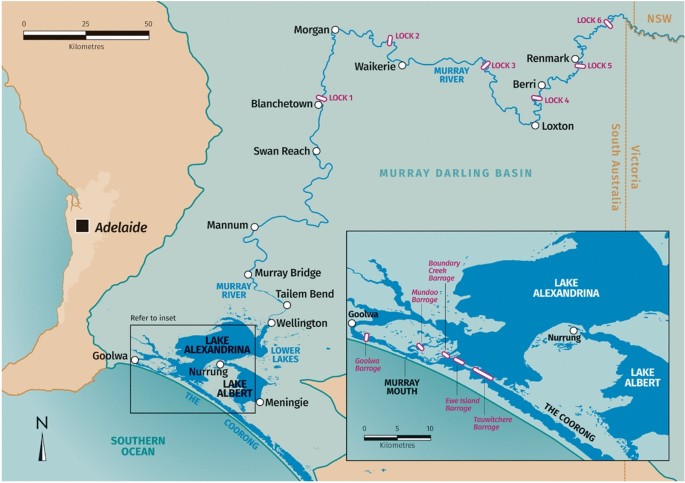
Weirs with locks to assist with navigation were planned for all the major rivers but only 11 were constructed from the late 1920’s to early 1930’s, all on the River Murray (Lock 1 at Blanchetown through to Lock 11 at Mildura). However commercial river navigation gave way to road and rail transport. Weirs continued to be built on all the major rivers for irrigation and town water supplies but locks were generally no longer needed.
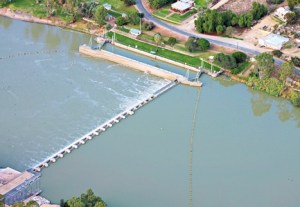

Lock 1 at Blanchetown
From 1935 to 1940, barrages were build to separate the salt water of the Coorong and the Murray Mouth from the freshwater Lower Lakes through to Lock 1 at Blanchetown which includes Adelaide’s water supplies.
(Click here for full size plan of weirs and barrages)
Weirs and Barrages on the Murray River in South Australia
However, by the 1960’s salt in the river due to irrigation was becoming a big problem in the Murray River and fifteen salt interceptor systems were developed in NSW, Victoria and South Australia as well as maintaining flows through the Murray Mouth to flush the salt out of the Basin rivers.
The Tasmanian Dam Case in the High Court in 1983, laid the foundation for a shift in the power relationship between States and Commonwealth for water management issues and gave the Commonwealth power to give effect to international treaties, particularly those concerning the environment such as Ramsar.
Despite the fact that over allocation of water within the basin was becoming more and more obvious, history suggests that only when there is a crisis, progress is made.
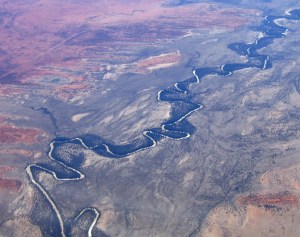
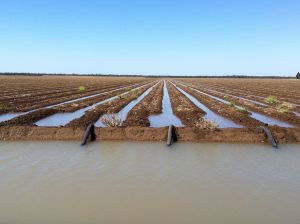
Darling River near Bourke Irrigation of Cotton near St George
In the early 1990’s that crisis was a toxic blue-green algal bloom affecting large sections of the rivers in the basin. In response the Murray-Darling Basin Commission was set up and a cap was put on allocations and a trading scheme was established for water licenses. However allocations were contested by the States and they were not enforced.
The millennium drought (from around 2000 to 2010) was the next crisis which spurred the Howard Liberal government to pass the Commonwealth Water Act of 2007 (http://www.austlii.edu.au/au/legis/cth/consol_act/wa200783/). This Water Act legislated the requirement to create water resource plans for all major river catchments to stop overallocation and environmental degradation. This was world leading legislation which required allocation of environmental flows to be returned to the river. The Act also legislated the formation of the Murray-Darling Basin Authority (MDBA) (http://www.mdba.gov.au/) to manage the implementation of the Water Act in the Murray-Darling Basin.
 Red Top Bay, Clayton Bay During the Drought
The MDBA developed the Murray Darling Basin Plan of 2012 (MDBP) (https://www.legislation.gov.au/Details/F2016C00574) as the key mechanism for implementing the Water Act to address over-allocation though a federal cooperative approach. https://www.mdba.gov.au/water-management/basin-plan
“The Water Act recognizes as statutory facts that:
Australia has over-allocated its water resources for consumptive uses such as irrigated agriculture;
This has caused and continues to cause serious environmental degradation;
We must take ‘special measures’ to stop this over-allocation and degradation. That special measure is the Basin Plan – the 2012 Murray Darling Basin Plan.
At its core is the determination of how much water needs to be taken from consumptive uses such as mining and irrigated agriculture and returned to the environment to allow for environmental degradation to be stopped and for Australia to fulfil its environmental treaty obligations.”
Richard Beasley, Counsel assisting the Murray Darling Basin Royal Commission Dead in the Water Glossary of Terms p vii.
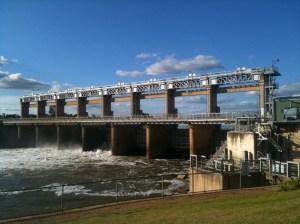
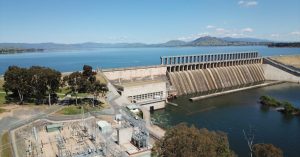 Yarrawonga Weir on Murray River Hume Weir on the Murray River
What does the Basin Plan Do.
The MDBP is required under the Water Act to use the ‘best available science’ to determine the sustainable diversion limit (SDL) for each catchment and for the entire basin. The MDBA undertook a massive research and audit to determine what water was being taken and how much water was required to sustain the environment i.e. the Environment Sustainable Level of Take (ESLT).
This study culminated in the release of the ‘Murray-Darling Basin Plan Review in 2010 which identified that between 3,900 and 7,600 GL/y would be required for the environment. These volumes were hotly contested, particularly by irrigators in Victoria and when the MDBP was released in 2012 the flow that was needed to be returned to the environment was identified as 2,750 GL/y.
South Australia contested this figure and it was subsequently agreed that the equivalent of 450 GL/y could be returned to the environment by Enhanced Environmental Outcomes through efficiency projects undertaken by NSW and Victoria. To date (mid 2025) only 28 GL/y has been completed and in November 2024, the Government approved the process of buy-backs of water allocations from willing sellers to help recover the 450 GL/y.
This then gave the equivalent of 3,200 GL/y for the environment.
However in 2018, Victoria and NSW managed to have the MDBP amended to provide the equivalent of 605 GL/y of environmental water through infrastructure projects which were called Sustainable Diversion Limit Adjustment Mechanism (SDLAM) and 70 GL/y from the Northern Basin to be reviewed. Leaving the remaining 2,075 GL/y, known as Bridging the Gap water, to be recovered by buy-backs.
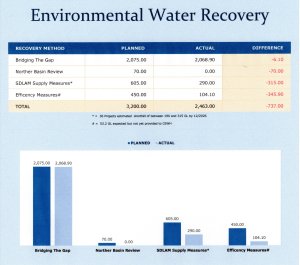
(Click here for Environmental Water Allocations Graphic)
The federal government have invested heavily in the implementation of the MDBP through such measures as the Sustainable Communities Program to help communities to adjust to water purchases and the Resilient River Water Infrastructure Program to assist in the recovery of the 450 GL/y through efficiency projects.
How is the Basin Plan Performing.
Since it was passed in 2012, the Murray Darling Basin Plan has achieved five of seven economic goals but only 2 of 12 environmental goals. (Peter Sainsbury at https://johnmenadue.com/post/2025/06/environment-murray-darling-plan-delivers-profits-but-not-environmental-improvement/ )
The Wentworth Group of Concerned Scientists’ report, titled Murky Waters Running Clearer, found the country’s largest and most important river system “continues to decline”. https://www.abc.net.au/news/rural/2024-12-02/murray-darling-basin-plan-failing-river-health-wentworth-group/104663684
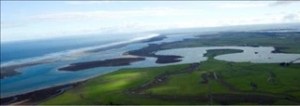 Mouth of the River Murray and the Coorong
The 2026 Basin Plan Review.
The MDBP is currently being revised for the first time since it was first legislated in 2012. The MDBA advise that this revision will focus on 4 key themes:
- Climate Change
- Sustainable Water Limits
- First Nations, and
- Regulatory Reform
The MDBA have advised that the timeline for deliverables in this review process are:
- Roadmap – mid 2023 https://www.mdba.gov.au/sites/default/files/publications/bpr-review-roadmap.pdf
- Early Insights Paper – mid 2024 https://www.mdba.gov.au/sites/default/files/publications/early-insights-paper-2024-10-03.pdf
- Basin Plan Evaluation – mid 2025 https://www.mdba.gov.au/sites/default/files/publications/what-we-have-heard-peak-groups-perspectives-to-support-the-2025-basin-plan-evaluation.pdf
- Outlook for the Basin – Late 2025
- Discussion Paper – early 2026
- Basin Plan Review: Final Report – late 2026
RLCAG position.
The River Lakes and Coorong Action Group supports the review of the Murray Darling Basin Plan as an opportunity to achieve a healthy working river system for all Basin users.
Principles for which RLCAG will lobby and seek support, especially with respect to the CLLMM region include:
-
- The River Murray should always be the priority.
- Committed to protecting and restoring the health of the Murray River.
- A river dies from its mouth.
- Connectivity of all rivers in the basin.
- Provision for First Nations cultural flows.
- Sustainable Diversion Limit based on Best Available Science.
- A fair share of water for everyone including the Environment.
- Environmentally Sustainable Level of Take.
- Impact of Climate Change addressed.
- Equitable compensation to communities adversely affected.
- Healthy Water Quality.
- Adequate and publicly available WQ monitoring.
- Best available predictive methods e.g. modelling.
- Best available technologies to respond to WQ issues.
- Regulation compliance, enforcement, accountability and transparency.
- Consistent water accounting, monitoring and reporting framework.
- Independent compliance authority to audit and enforce the MDBP.
- The River Murray should always be the priority.
 River Lakes & Coorong Action Group Inc.