RLCAG has a track record of engaging with Murray-Darling Basin matters though submissions, symposia, meetings and campaigns. RLCAG has made over 25 submissions since 2006 regarding government inquiries and actions on environmental matters.
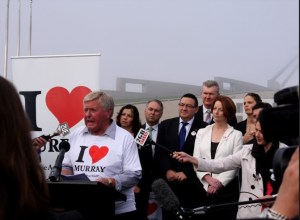
Our focus is on our region and on the system as a whole. The lower Murray River, Lake Alexandrina and Lake Albert and the Coorong are critical to the Murray Darling Basin as a whole because this region is the canary in the mine. Rivers die from the mouth up. If this region is healthy, upstream is more likely to be healthy. We are critically concerned with the health of the river system as a whole, necessitating a fair allocation of water for all users including the environment.
Video “A River Dies from the Mouth Up” on the Coorong Lower Lakes and Murray Mouth region.
We remain concerned that:
- Environmental health must remain the base indicator for the health of the system as a whole.
- The Sustainable Diversion Limit (SDL) for the recovery of 3,200 GL of water for the environment will prove to be insufficient. Scientific modelling during the development of the Plan showed that between 3,900 and 7,600 GL would be needed to maintain the health of the system.
- The strategy of Adaptive Management adopted by the MDBA may enable the ongoing privileging of economic needs upstream.
- The MDBA may not continue to receive full support of the Federal Government to implement the Plan in full and on time.
What will a successful Murray Darling Basin Plan provide?
The Basin Plan must return enough water to the rivers of the Basin to:
- Flush out the salt in the Murray River so the water is usable.
- Keep the Murray Mouth open with an adequate end of river flow.
- Protect and restore the Basin’s key environmental assets and function including the Basin’s 16 internationally significant wetlands. The overarching goal is to achieve a healthy river system. This can only be achieved by maintaining the small fringing wetlands, marshes, floodplains and other environmental assets in good health. The Plan needs to allow for an adequate volume of water to achieve this, not just an adequate volume of water to provide for selected icon sites. The small wetlands are the lifeblood of the system and if they are not allowed to function to their full ecological capacity it will be the death of the system. Examples in South Australia are Paiwalla, Swanport, and Martin’s Bend.
- Halt the decline of waterbirds, fish, red gums and other flora and fauna. Five hundred year old red gums, the Murray cod, Regent parrot and southern pygmy perch are irreplaceable.
- Prepare the environment so that it copes better during drought.
- Increase frequency and duration of floodplain inundation.
- Reduce blue-green algal outbreaks.
RLCAG’s Strategic Framework
Our Vision is to achieve a healthy River based on science and First Nations knowledge, for all users including the environment.
Our Mission is to protect, conserve and enhance the biodiversity of the River Murray, Great Southern Lakes and Coorong by ensuring environmentally sustainable quantities of healthy water continue to flow to this area and this water is managed for the benefit of the First Nations people, the environment, current beneficiaries and future generations.
Our Key Strategies and activities aimed at achieving our Mission include:
- Liaison and promotion of the interests of the Ngarrindjeri People.
- Liaise with relevant authorities including MDBA, DCCEEW & SADEW.
- Lobbying for community support of relevant issues.
- Co-operation and representation with other relevant organisations.
- Promote relevant scientific knowledge.
- Identify the need for further scientific research.
- Participate in research projects where appropriate.
- Help promote and disseminate relevant research findings.
Click here for RLCAG’s Strategic Framework.
 River Lakes & Coorong Action Group Inc.